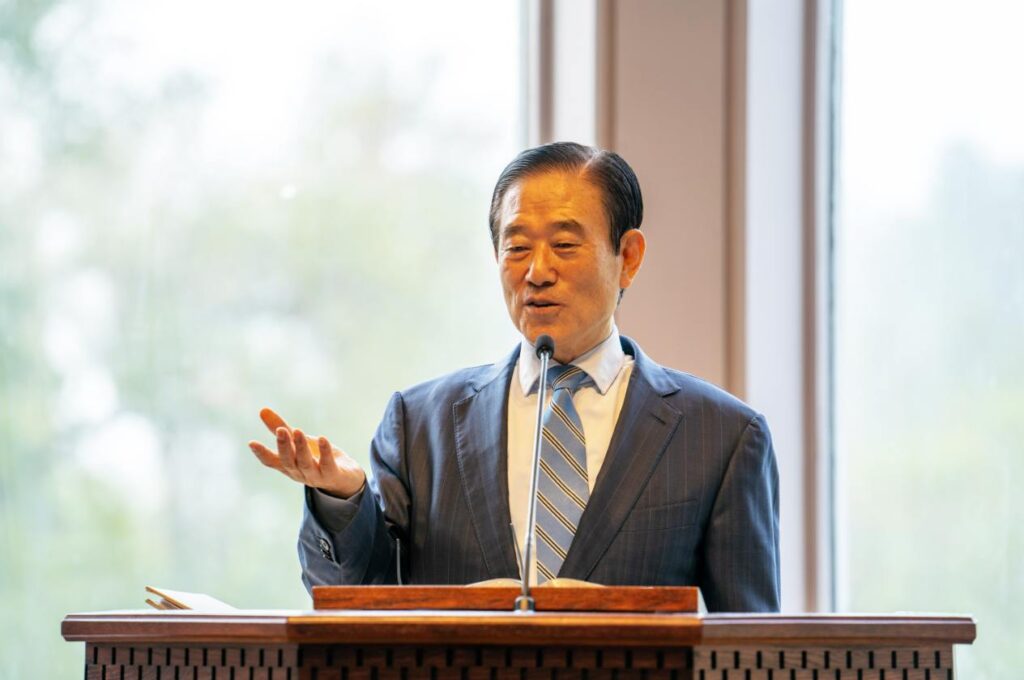
The French philosopher Simone Weil once said, “Paying complete attention is the essence of prayer.” This sobering insight—that where our gaze rests, there our heart is, and where our heart is directed, there the destination of our life is determined—comes to us today as an even sharper truth in an age when everything seeks to seize our attention. In a time flooded with meaningless information and momentary stimuli that overwhelm the soul, to what are we giving our spiritual attention? Through Paul’s urgent exhortation recorded in 1 Thessalonians 4, Pastor David Jang’s sermon offers a weighty and profound invitation to recover the gaze this age has lost and to realign the direction of life completely within grace. The single phrase “finally,” which Paul uses near the end of his letter, is not merely a closing remark on the page. It is a holy turning point that completely transforms the believer’s spiritual gravity, leading the faithful beyond justification and toward sanctification. When countless voices of this age stir up anxiety and urge us toward faster achievement, the message of this passage calls us to stop our hurried steps and honestly look into the depths of our souls.
A Holy Calling and Biblical Meditation That Realign the Direction of Life
As we carefully read Paul’s text, we come to realize that the phrase “do so more and more” is not a rhetorical demand for simple moral exertion or a temporary elevation of emotion. This sermon makes clear that what is required in this passage is not momentary passion but sustained will; not the evaporation of feeling, but habituated obedience scattered throughout life and rooted deeply within it. If we have already learned how to please God, that learning must never remain merely a slogan beside our pillow. The essence of faith testified to in Hebrews, the test of love Jesus placed before Peter in the Gospel of John, and Paul’s own stated motivation not to please people all converge on this one clear focus. The true beginning of spiritual literacy is the instinct to make this the first question before every decision: “Will this choice please God?”
The flow of the Word quietly traces the gentle upward curve of sanctification, moving beyond justification—the threshold of salvation—and into the shaping work of the Holy Spirit. For those who have been justified by faith, holiness is neither an abstract doctrine forever beyond reach nor a distant ideal reserved for the future. It must be read as an overwhelming command of existence, one to be engraved onto today’s screen, into the movements of our fingertips, and within the tightly woven schedule of each day. The more our eschatological longing for the Lord grows, the more thoroughly we must guard against spiritual fanaticism that neglects responsibility in the present. Only when tension and daily life, burning passion and cool diligence, mesh together like interlocking gears does holiness become not a one-time performance but an unshakable structure that sustains life. If justification is the freely given gift of grace, then sanctification is the holy response that those indebted to that grace must rightly repay through their daily lives.
The Place of Faith and Repentance That Resists the Inertia of Everyday Life
To establish holiness as a firm structure of daily life, painful distinction is inevitably required. Just as Moses had to quietly remove his sandals before the burning bush, faith is not indiscriminate affirmation. It is the work of dividing space and distinguishing time, drawing firm boundaries against the flow of desires that violate the inner self. Recognizing what unsettles the heart, where our gaze and hands linger the longest, and what kinds of content are training our spiritual imagination in worldly ways is the first step of repentance. Pastor David Jang points out that just as the gospel spreads like leaven, sexual immorality and compromise that corrode the soul also infiltrate a community quietly like leaven. Because even the smallest tolerated crack can eventually collapse an entire moral sensitivity, only the decision to boldly cut off the channel and stop the flow becomes a healthy principle that preserves life.
In this context, cutting off the channel becomes a very concrete practice of redesigning our technological habits and digital environments today. Against the immense inertia of algorithms that lead the soul into lethargy, the believer must launch a conscious and holy counterattack. A routine that fills the empty hours of the morning first with the Word, a habit of brief meditation before unconsciously opening a messaging app, and small disciplines of turning off the light of the screen before sleep and deeply contemplating a paragraph of truth—these are small but most certain forms of distinction that separate us from the world. Sanctification is not born from extraordinary and majestic events of decision, but grows through the tedious repetition of small choices with low thresholds. Like the meditation on the Chinese character “聖” meaning “holy”—set apart by hearing and strengthened by proclaiming—only the spiritual rhythm of hearing the Word with our ears, confessing it with our mouths, and living it out with our lives can preserve faith intact amid the muddy currents of the secular world.
The Gospel of Love and Respect That Blooms in the Nearest Places
The word “holiness” can easily become preserved like a relic within religious spaces, but the true weight of faith is always measured in the crevices of our closest relationships. Paul’s exhortation to treat one’s wife with holiness and honor was a great event in which the gospel brought a noble correction of mutual respect into an ancient oppressive structure where power was tilted heavily in one direction. When this shining theological insight is brought into today’s families and relationships, it blossoms in the deeply warm and concrete language of daily life: consideration and trust. The depth of faith is not verified only by splendid spiritual vocabulary or passionate worship in public gatherings. Rather, before anything else, ordinary gestures—truly listening to the voice of the person beside us, not carelessly exposing another person’s wounds, admitting our mistakes, and apologizing—vividly restore the warmth of holiness.
Furthermore, the essence of brotherly love for which the Thessalonian church was praised is deeply contemplated through the word “emptying.” Regardless of how much or how little one possesses, the soul hardens if one does not empty oneself; but when one willingly empties oneself, grace flows like a river that never runs dry. Even amid a busy life, when small acts of labor gather together—offering to accompany an exhausted brother or sister late at night, quietly filling another person’s lack with one’s own abundance—a dense trust forms within the community that the world cannot imitate. The quiet assurance that, even if someone falls, there will be someone willing to stand beside them and offer a shoulder, raises up again those who have fallen into despair. When truth resounds not as polished and fluent language but as the rough yet sincere warmth of life, the wounded and wandering finally discover a resting place for the soul where they can catch their breath.
Quiet Obedience and Radiant Hope That Still a Noisy Age
Under the harsh pressure of modern society, where people feel they must constantly prove their worth in order to survive, many paradoxically experience severe exhaustion of the soul, unable to complete even one thing properly. Amid this fatigue of the age, the biblical exhortation to “live quietly,” “mind your own affairs,” and “work with your hands” offers a deeper and firmer sense of liberation than almost any comfort. Those who carry the eternal hope of heaven faithfully remain in the place of diligence they must bear today, even if the world were to end tomorrow. Fulfilling responsibilities at the appointed time, not taking lightly the honest labor of working with sweat, and willingly returning what one has learned for the benefit of one’s neighbor—this is the contemporary form of a holy calling.
This attitude of life that does not depend excessively on anyone goes far beyond the dimension of simple economic independence. It is the deep inner freedom that is not swayed by the gaze of others or the shallow opinions of the world, and it is the beautiful expression of disciplined energy that does not lose orderliness and responsibility even in an unjust world. At the same time, this quiet obedience is never reduced to a merely private sphere. Because we fully trust the God who wipes away the tears of the wronged and vindicates them, that faith expands into active love and ethics that willingly move toward the side of the suffering and vulnerable. To believe in God’s vindication does not mean remaining silent and passive before the pain of the age. It is the holy courage to adjust the direction of our steps toward the places where God’s compassion is directed and to stand in solidarity there.
When the movement of 1 Thessalonians 4 conveyed in this sermon is overlaid onto the trajectory of today, the scattered fragments of everyday life finally become woven into one whole story of salvation. Holiness is never a closed and cold wall built layer upon layer against the world. Rather, it is a spacious and green field of life into which anyone may enter and catch their breath. As we open the beginning of the day with meditation, change unconscious scrolling into a confession of gratitude, and quietly rearrange the small and seemingly trivial choices of daily life beneath the grace of the cross, we encounter faith in its clearest form. We must not forget that a life pleasing to God may appear to be the narrowest and most inconvenient path, but in truth it is the radiant trajectory through which our souls become most spacious and most truly human. At the end of all meditation, one quiet question remains: Is the silent step you take in your daily life today becoming the most beautiful footprint of obedience, moving against the vast inertia of the world and toward eternal hope?