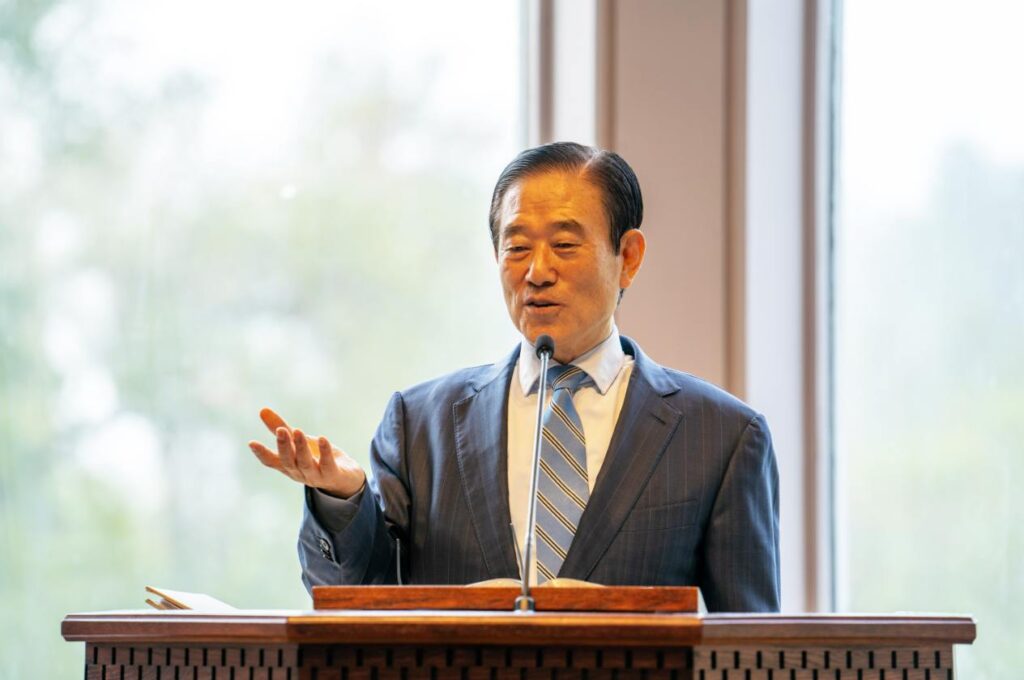
When one quietly listens to the polyphony of Johann Sebastian Bach, one is overwhelmed by the wondrous mystery of different independent melodies that neither collide nor scatter in the air, but finally merge into one majestic harmony. Each voice has its own place, rhythm, and tempo, yet all these diverse sounds ultimately converge into one single praise directed toward the Absolute. The spiritual landscape we encounter in Pastor David Jang’s exposition of 1 Corinthians 12 and Romans 12 touches this same profound musical sublimity. Across the spiritual horizon opened in the first paragraph, it becomes vividly clear how the spiritual gifts distributed to each person breathe organically and pulse powerfully within the one body called Christ. The “unity in diversity,” in which difference does not become a seed of division or a spark of conflict but rather an essential pillar supporting the complete church, is not confined within the abstract framework of doctrine. This absolute principle—that the great grace flowing from one Lord, one Spirit, and one God is distributed in diverse forms of people, offices, and ministries to build up the community—broadens our narrow vision.
Spiritual Gifts Formed by Grace, and the Place of Equality Opened by the Gospel of the Cross
The first gate opened by the Word is to see clearly the essence of spiritual gifts. The fact that the Greek root of the word “gift” reaches back to charis, meaning grace, establishes a crucial milestone in our journey of faith. A gift given by grace does not, from the beginning, ask for human merit or qualification, nor does it demand any payment in return. Therefore, the talents, opportunities, and offices we enjoy in daily life and ministry can never become trophies of achievement won through fierce competition. They are only reasons for overwhelming gratitude and responsibilities of a mission we must faithfully bear. When this gospel truth takes deep root in the soul, the destructive poison of comparing ourselves with others—whether by envying them or endlessly lowering ourselves—finally drains away. The fundamental transformation by which we, who once wandered among the silence of idols, now confess Jesus as our Lord is itself the first key that opens the door to all gifts. Because everyone has passed through the same door of grace, no one can be superior; and because different gifts have been assigned to each person according to divine wisdom, there can be no unnecessary person within the church.
Daily Life Blossoming According to the Measure of Faith, and the Path of a Holy Calling
Pastor David Jang’s message does not remain only within the safe space of the temple courts. It steps boldly into the intense realm of vocation where believers stand and live each day. The history of the Huguenots, who had to scatter across the European continent to escape fierce persecution and who accepted their difficult survival in unfamiliar lands as God’s holy calling, leaves a deep resonance. Their remarkable achievements in precision machinery, finance, and the clothing industry amid harsh realities were the fruit of outstanding theological insight: they interpreted the sweat of their labor as a holy extension of worship. When I realize that the workplace I face every day and the occupation I hold are not merely temporary means for earning a living, but glorious places entrusted to me by God, the dignity of work rises to an entirely new dimension. The language of “the measure of faith” recorded in Romans 12 carefully refines this logic of calling. The exhortation not to think of oneself more highly than one ought, but to understand oneself according to the measure wisely distributed by God, is not merely a call to moral modesty; it is a theological command. Just as the hand cannot replace walking, and the foot cannot replace sight, the body of Christ is built up fully when each of us faithfully keeps our own portion in daily life.
Spiritual Discernment Sharpened by Biblical Meditation and the Mystery of Oneness
When we quietly meditate on the lists of gifts recorded in 1 Corinthians 12 and Romans 12, we come to realize that they are arteries of life, carefully designed to serve the world and revive the church. The reason prophecy stood at the forefront in the early church of Antioch was that it served as a spiritual lighthouse, discerning the will of God in the darkness and illuminating the course of the church. Service firmly supports the fragile structure of the community, teaching embodies the truth, and giving and mercy preserve the warm temperature of God’s kingdom in the midst of a cold reality. The word of wisdom, the word of knowledge, and the heavenly power of healing and mighty works—dýnamis—awaken spiritual numbness toward sin and revive hardened hearts. Especially in this age flooded with information and noise, the gift of discerning spirits, by which one identifies what is truly the voice of God and what is merely the vain desire of the inner self, is like a lifeline. Even the prayer of tongues, which expresses the deep groaning of an individual soul, must be ordered within the community through the gift of interpretation so that it builds up the virtue of unity. A spiritual gift fulfills its holy purpose only when it is translated beyond my personal spiritual experience into our public benefit.
True Worship Offered with Hope and the Devotion of the Remnant
The rich teaching on spiritual gifts conveyed by Pastor David Jang boldly extends beyond individual spirituality into the realms of education, culture, and institutions. The history of Western universities gives a weighty warning: even if academic diversity expands infinitely, unless it is anchored in the one unifying purpose of “the glory of God,” it will eventually be swept away and decline under secular currents. This is why Christian educational institutions such as OU must preserve to the end the centrality of the gospel of the cross—“raising global leadership necessary for the mission of the church.” Yet all these holy missions can sustain their vitality only through the restoration of true worship. In the mystery of the Lord’s Supper, where we praise with tears in one voice and share the torn flesh and blood, the astonishing experience of our fragmented selves being reassembled into one complete body can never pass through a cold screen. The command to keep the Sabbath is a holy consideration from God, calling us to reaffirm our lost identity, wounded in a harsh world, and to receive the spiritual resilience to live again.
“God has given, God has distributed, and God uses.” This clear declaration about spiritual gifts is an echo of the gospel that shakes the rest of one’s life. In modern society, where people experience both specialization and isolation at the same time, if the church is to exist as light, the expertise of spiritual gifts—depth—and the direction of the kingdom of God must align precisely. The pulpit and the field of daily life, leadership and quiet followership, are not rivals that push each other away, but holy partners. Destructive competition over gifts impoverishes the soul, but the devoted exchange of gifts powerfully revives the life of a broken community. Today, are you using one another’s differences as an excuse for division, or as bricks of grace that create a greater wholeness? We are led to ask again and again in prayer whether the true worshiper who freely lets flow, in the way of grace, what has been freely received by grace is indeed the hope God is seeking in this age.