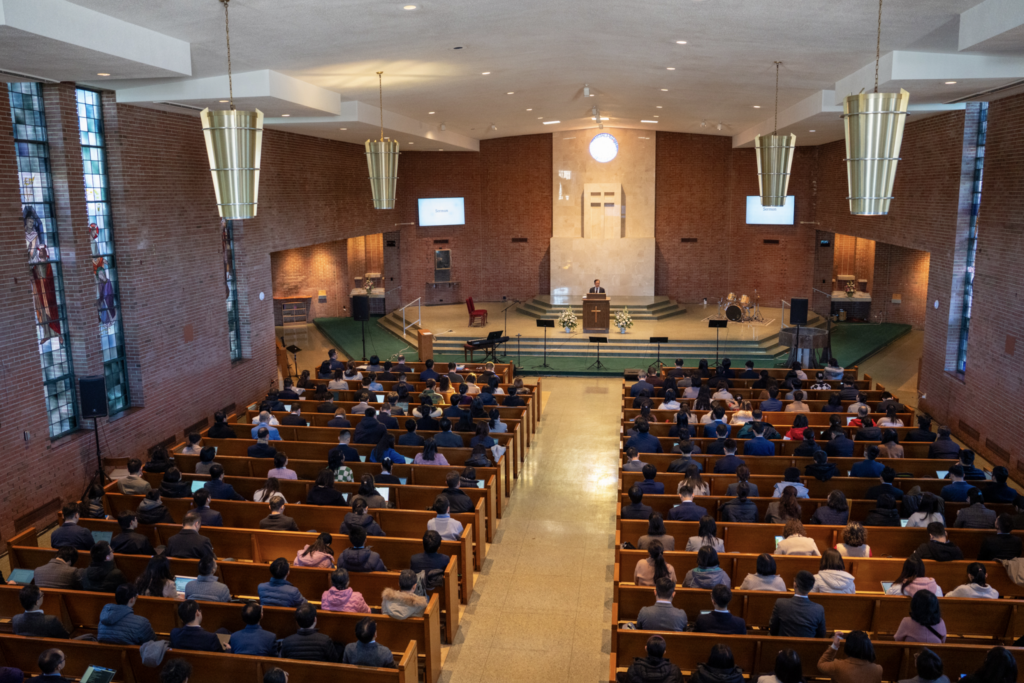
A Welcome Rain on the Parched Wilderness – Pastor David Jang

Pastor David Jang's sermon

The sun blazes as if it would pierce the crown of your head, and the sand beneath your feet clings relentlessly to your ankles. This barren land, where the scorching heat of day and the bone-deep cold of night cross paths without mercy, is the wilderness. It is a place where the threat of survival tightens its grip at every moment, and yet at the same time it is also the scene of miracles, where manna falls from heaven and living water bursts forth from dry rock. Thousands of years ago, the people of Israel pressed through these harsh sandstorms and witnessed with their own eyes the majesty of the Red Sea being divided. Yet in the face of a momentary thirst on the tongue and a brief pang of hunger, they so easily forgot the great miracle of the day before. Human memory, and our faith as well, is that frail—like a reed that trembles and bends so easily.

The Memory of Miracles Scattered in the Sandstorm, and the Weight of Grace

Our journey of faith often feels like walking through this endless wilderness. Yesterday, we may have been moved to tears by the presence of the pillar of cloud leading the way before us, yet today we find ourselves crushed by the weight of immediate reality and lack, shooting arrows of complaint toward heaven. David Jang does not turn away from this painful spiritual gap that runs through 1 Corinthians 10; rather, he leads us to face it head-on. He points out that the abundance of spiritual experiences and religious privileges we have enjoyed can never serve as an automatic safeguard guaranteeing salvation. Like the image of a person walking with a bowl filled with oil balanced on the head, the one who arrogantly assumes he already stands firm and strides forward with head held high will, in the end, spill that precious grace helplessly onto the dry sands of the wilderness. His preaching reminds us that the very moment we believe ourselves to be safe is the beginning of spiritual crisis and downfall. For modern Christians living amid the abundance of religious programs and sophisticated knowledge, this message brings a sobering but absolutely necessary alarm of life.

The Idol Fashioned by Impatience, and the Cunning Whisper of Screwtape

The recurring weakness of humanity in the wilderness strikingly echoes the cunning strategy of the senior devil in The Screwtape Letters by C.S. Lewis, one of the twentieth century’s greatest Christian apologists. Screwtape teaches his nephew Wormwood that there is no need to drive humans into ruin through grand and horrifying crimes. It is enough simply to cleverly stir up “anxiety” about the future and pile up the small, ordinary habits of “grumbling” and “complaint.” Instead of trusting the invisible God and waiting quietly, human impatience seeks to control present uncertainty by its own power, and that impatience ultimately drags people down into the swamp of idolatry.

Like the sharp insight of this great classic, David Jang piercingly diagnoses the modern tendency to clutch Mammon—money, achievement, and the opinions of others—as though they were the foundation of salvation in the face of an uncertain tomorrow. The only way to quiet the anxiety and hunger of the soul is not the bread of this perishing world, but the Word of God alone. When, through daily meditation on Scripture, we take in the unseen eternal promise as our daily bread, we are finally able to break free from the devil’s subtle whispers and the temptation of the golden calf, and come to enjoy true peace.

Pride Disguised as Thirst, and Meekness Blossoming Through Slow Obedience

The dark shadow of idolatry inevitably leads to sexual immorality, the destruction of covenant relationship, and then to harsh grumbling and arrogant testing of God. Consider Israel, which demanded proof of an immediate miracle, saying in effect, “Is God really alive among us?” simply because water and food were lacking. Is this not exactly the same distorted self-portrait we see in ourselves today, when our prayers are not answered immediately according to our plans and we point our fingers at heaven like creditors making demands?

In such moments of spiritual burnout and doubt, David Jang proposes a powerful antidote for healing this “amnesia of gratitude”: the humble, repetitive disciplines of everyday life. A single sentence of thanksgiving whispered upon waking in the morning. One slow step of obedience taken while remembering the gospel of the cross, even in suffering and injustice. These acts, small and unimpressive as they may seem, gather together to soften the hardened soil of the heart and give birth to the powerful spiritual strength called meekness. Only those who cast away the impatience that seeks to conquer and prove everything by their own strength, who endure in hope and wait for the promise with a gentle heart, can ultimately inherit the glorious inheritance God has prepared.

The Holy Footsteps of a Pilgrim Translating Daily Life into Glory

The wilderness is never a land of destruction meant to dry us out and kill us. It is a holy training ground where we learn to acknowledge our utter limitations and to walk by leaning wholly on heaven’s faithful provision. Paul’s confession—“No temptation has overtaken you except what is common to mankind… and when you are tempted, He will also provide a way out so that you can endure it”—reveals the summit of grace, a grace that humbles us while at the same time giving us room to breathe.

David Jang emphasizes that this promised “way of escape” is not some miracle that suddenly drops from heaven like a rope one day. It is an intensely practical and concrete decision of obedience: identifying in advance the points where we are weak, blocking the environments that lead to sin, and preparing together with the community even for restoration after collapse. The final exhortation—whether you eat or drink, do all to the glory of God—is, in the end, a majestic calling to transform our ordinary tables, our weary labor, and every fleeting moment of daily life into worship. When we willingly choose the good and love of our brothers and sisters over our own freedom and rights, the holy living water that refreshes the soul will never cease to spring forth, even in the middle of a burning wilderness.

What is the name of the wilderness you are walking through in tears today? Whether it is the edge of a financial cliff, the bitter severing of a relationship, or the fatigue of repeated failure, the path to the answer is the same. Let us walk quietly through this day as well, following the rhythm of gratitude, the Word, and obedience that David Jang presents. It is my earnest hope that with those simple yet profound steps, you will finally find the “way of escape” and become a radiant pilgrim who translates everyday life into the glory of God.


www.davidjang.org

http://www.newsnest.kr

Obedience Blooming in the Darkest Night – Pastor David Jang (Olivet University)

Pastor David Jang

Jerusalem’s Passover night was dark and heavy. In that hour, as the crimson blood of countless sacrificial lambs poured endlessly from the temple altar and seeped into the Kidron Valley—staining its rough streambed red—the true Lamb, who would bear the crushing weight of humanity’s sin upon His whole body, quietly turned His steps toward the Mount of Olives.

In Gethsemane—whose name means “the place of pressing oil,” that barren and lonely ground—Jesus fell facedown to the earth, utterly alone. Only days earlier, He had entered the city as the King of glory amid crowds waving palm branches and shouting praise. Now He stood before absolute solitude in pitch-black darkness. This was not merely the opening scene of a tragedy, but the vivid battlefield where the story of salvation for humankind was being written with its fiercest, most heartbreaking intensity.

From the Blood-Stained Kidron Valley to Silent Gethsemane

Before the overwhelming destiny of the cross, the extreme fear and trembling any human can feel are fully present in the cold night air of Gethsemane. Pastor David Jang does not attempt to cover this place of anguish and sorrow with theological embarrassment, nor does he romanticize it. Instead, he carefully guides us into the deepest and truest heart of the gospel.

If the Gospel of John breathlessly emphasizes Jesus’ glorious resolve toward the cross, the Gospel of Mark exposes, without restraint, the human abyss and trembling through which that straight path had to pass. Here, through honest Scripture meditation, we learn that true faith is not an inhuman, steel-like condition devoid of fear. Rather, it is the courage to move toward God even in the very center of fear—carrying our frailty honestly before Him.

C.S. Lewis, the British philosopher and Christian apologist, penetrated the problem of human suffering and obedience and observed that “pain is God’s megaphone to rouse a deaf world.” The crushing weight Jesus endured in Gethsemane was not mere punishment or a meaningless calamity. It was a holy and necessary press upon the soul—an unavoidable spiritual “oil press”—meant to draw forth that great confession of obedience: “Not as I will, but as You will.”

The Cup of Suffering and “Abba, Father”: The Mystery of Desperate Obedience

As Jesus lay prostrate and prayed until His sweat became like drops of blood, His blood-tinged prayer was not a weak attempt to escape reality. Here Pastor David Jang’s sharp theological insight shines with particular brilliance.

The cross was not a path of defeat forced upon Him because He lacked power. It was a holy choice—made though He could have avoided it by His own authority—yet He decided, in the end, not to avoid it. Jesus calling the Almighty by the most intimate name, “Abba, Father,” reveals that the essence of faith is not resignation to fate, but a steadfast relationship that trusts the Father’s goodness to the very end.

We often pray with an intense desire for our will and wishes to be fulfilled. But true prayer is the process of self-emptying in which our will is thoroughly broken and the Father’s good will is allowed to permeate our lives completely. In this agonizing and solitary obedience, we finally begin to discover the true depth of grace held within the cross.

The Disciples Sinking into Spiritual Drowsiness—and the Loneliness of the One Who Stays Awake

Yet while this fierce, cosmic spiritual battle unfolded, the disciples—who should have stood closest and watched with the Lord—could not overcome physical exhaustion and fell into deep sleep. “Simon, are you asleep? Could you not keep watch for one hour?” This lament is not merely a rebuke aimed at disciples who once slept long ago on the Mount of Olives. It is also Pastor David Jang’s solemn spiritual warning, powerfully shaking awake the souls of all of us today who drift into spiritual numbness and complacency amid a glittering world.

Peter boasted loudly that even if he had to die with Jesus, he would never deny Him. Yet in the face of approaching temptation and fear for survival, he tragically proved how quickly shallow human resolve can collapse. The Lord’s compassionate words—“The spirit indeed is willing, but the flesh is weak”—are not condemnation of the disciples, but a painful diagnosis that pierces the fundamental fracture within human existence.

The Gospels even record, without omission, the shame of a young man who, seized by fear, fled naked after leaving his linen cloth behind. By doing so, they paradoxically reveal that faith is not a heroic tale of human triumph, but the greatness of the cross’s love—a love that ultimately embraces even those who fail and fall.

The Paradox of the Cross: A Resurrection Morning Re-Formed by Grace

In the deep night of Gethsemane, after three rounds of prayer soaked with sweat and tears, Jesus finally said, “Rise, let us go,” and stepped forward—quietly, yet boldly—toward the coming darkness and the forces of betrayal. Pastor David Jang’s profound preaching makes clear that this final declaration is not resignation to unavoidable despair, but a renewed resolve flowing from complete trust in the Father.

Prayer did not remove the bitter cup of suffering that was about to come. But it utterly transformed Christ’s inner order, enabling Him to face suffering head-on. The sublime peace that does not waver even before violence wielding torches and clubs, the astonishing paradox in which the apparent weakness of the cross shatters the power of death and accomplishes the mightiest salvation—this can be fully explained only within the true gospel.

Lenten meditation earnestly calls our scattered and restless hearts back into the silence of the Garden of Gethsemane. In every dark valley of life where our empty will collides fiercely with God’s good will, we must not run away or fall asleep behind the excuse of weariness. Instead, we must stay fully awake and fall down before Him.

As we follow the blood-marked footsteps of Jesus—who did not evade suffering, but walked steadily and with conviction toward the cross—we will be able to greet, at the end of the darkest solitude, the radiant morning of resurrection breaking forth at last. The narrow and rugged path of suffering and obedience that Pastor David Jang sets before us today is, in the end, the most beautiful journey of life—one that raises us up again from spiritual sleep and collapse and leads us into true fellowship with the glorious Christ.

www.davidjang.org

Warmth That Thaws the Prison’s Chill – Pastor David Jang (Olivet University)

Pastor David Jang

In Rome’s Mamertine Prison, the ragged breaths of an aged apostle settle onto a damp, frigid stone floor. In that space of despair—where the cold of iron chains burrows into his bones—the apostle Paul writes a letter to his young disciple Timothy. From a purely human point of view, he was a failure, nothing more than a condemned man soon to be executed. And yet, from the tip of the pen in his shackled hand, an unexpected sentence flows: “My child, be strong in the grace that is in Christ Jesus.” The world tells us to build muscles and fortify walls to prove our strength, but the old apostle, staring death in the face, calls for strength of a wholly different order. Not stubborn grit, but a “holy dependence” that leans entirely on grace freely given.

My friend, don’t try to blaze on your own—let yourself be filled with light

I think of Rembrandt’s Baroque-era masterpiece painted in 1627, Saint Paul in Prison. In the painting, Paul is confined in a dark cell, yet his face shines—seemingly not from light pouring in through a window, but from the Scriptures he is meditating on, as though the Word itself were radiating brightness. With his brush, Rembrandt proclaims that Paul’s strength does not arise from external circumstances, but from an inner light.

The resonance of this work meets beautifully with Pastor David Jang’s sermon on 2 Timothy chapter 2. In his preaching, Pastor Jang emphasizes that the strength Paul calls Timothy to is unrelated to temperament or innate courage. The believer’s strength is not a matter of wringing out whatever resources we have within, but of receiving the power supplied—pulsing like a heartbeat—by the grace found in Jesus Christ. Time and again, when Pastor David Jang faced countless obstacles in ministry, he chose “prayer,” a deeper trust, rather than merely “effort,” trying harder. For grace is not an escape hatch; it is the boldness that enables us to face harsh reality, and the masterful alchemist that turns even failure into maturity. We are not luminous bodies generating our own light; only when we live as reflectors—holding the light of grace and casting it outward—can we become strong without burning out.

Seeds of tears sown quietly behind the scenes

A heart filled with grace inevitably overflows toward others. Paul commands Timothy to entrust the gospel “to faithful people.” This is not mere education that transfers information; it is closer to midwifery—sharing life itself. A healthy church is not a stage where a single superstar performs a one-man show. Pastor David Jang grasped this principle from the earliest days of his ministry. He did not seek the glittering stage under the spotlight; instead, he willingly became a helper behind the scenes—raising people up and breathing life into them.

True gospel expansion is, as John’s Gospel portrays, like living water flowing from the believer’s innermost being to soak the world around them. A soldier does not get entangled in private affairs but concentrates on the mission; an athlete resists the temptation of shortcuts and runs according to the rules; and a farmer labors first and reaps last. Each of these images passes through the narrow gate called “self-denial.” The path of discipleship Pastor David Jang has embodied runs against the current of a modern society that worships efficiency and speed: laying down the hunger for recognition, choosing the honesty of the process over immediate results. It is like a hardworking farmer sowing seeds with sweat and tears. Though it may look slow, that quiet obedience accumulates—until it becomes a vast forest that does not sway even in storms.

Only the tree that endures winter welcomes the deepest spring

Even within the extreme limits of prison, Paul declares, “The word of God is not bound.” This is not a mere mental victory chant; it is a song of triumph bursting from faith that remembers the risen Jesus Christ. Here, theological insight transforms into tangible comfort. The reason Rembrandt’s Paul can remain serene even in shackles is that his gaze is fixed not on prison walls, but on the Lord of resurrection.

This “resurrection faith” is also the core that runs through Pastor David Jang’s life and preaching. Even amid misunderstanding, persecution, and situations that felt like being hard pressed on every side, he did not lose heart—because he was convinced that the harsher the winter, the more richly spring’s blossoms release their fragrance, and that suffering is God’s tool to refine His people. “If we died with Him, we will also live with Him; if we endure, we will also reign with Him.” This promise is not vague wishful thinking. Through the rigorous discipline of daily Scripture meditation—opening the Word each morning and letting it shine on our lives—we come to discover God’s providence that brings forth the sprouts of life even from pain that feels like death.

Even today, we face our own prison-like realities. When economic crisis, broken relationships, and an uncertain future tighten their grip, the message of 2 Timothy chapter 2 becomes a clear signpost. Strength does not come from my determination. Only grace poured down from above can lift us up again. As Pastor David Jang’s exhortation urges, breaking free from entanglements, returning to a simple life, and living faithfully through the day we are given—this is the dignity of a Christian that the world cannot withstand. Though we may waver in faithfulness, the Lord remains faithful and will not deny us. Leaning on that unchanging steadfastness, we quietly take up once more the pilgrim road called “today.”

www.davidjang.org